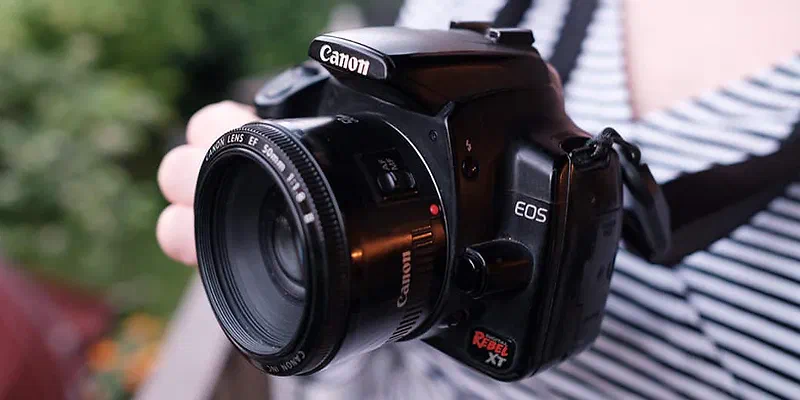
I find the early 2000s an interesting time for cameras: the first DSLRs were coming out, but professionals were still shooting analog film SLRs. Back then I was a teenager who had just started university, and all I had were shitty digital point-and-shoot cameras. Looking back, I would have loved to own a good camera to document my youth. The question is, what should I have bought back then?
Analog film was still king in the early 2000s, and that would probably have been the best option. But for a beginner, analog film is terrible. You have to burn through a lot of film and money to gain experience, and I would probably have given up.
In digital photography, some good options for consumers started to appear in the early 2000s. The Canon EOS 300D (aka Digital Rebel) from 2004 was known as the first good DSLR at a price ordinary people could afford ($999 with the kit lens). I remember going to Roskilde Festival in 2006 and thinking about buying the Canon EOS 350D (aka Digital Rebel XT) from 2005. Looking through old Danish catalogs, I can see that it cost 7495 DKK (1000 euros) with the kit lens at release, which wouldn’t have been impossible for me back then.

I didn’t buy the Canon EOS 350D back in 2006, but in late 2020 I found a good deal on one for 150 DKK (20 euros) and bought it. I’ve always wanted to know how the camera would have performed if I had bought it back then, and how much has changed since.
Specs
Here are some of the epic specs of the Canon EOS 350D:
- 8-megapixel CMOS sensor
- APS-C sensor.
- Up to ISO 1600!!!
- RAW support
- CompactFlash card slot.
- Works with all EF lenses.
Also check out this old Canon EOS 350D commercial:
The camera is pretty small. It feels very cheap, and the plastic look hasn’t aged well. Apart from that, it still works great and basically feels like a modern DSLR.
The camera came with the kit lens, the Canon EF-S 18-55mm f/3.5-5.6 (the old version). I know that’s a bad lens, so I bought a lens I could also have afforded back in 2006: the Canon EF 50mm f1.8 II (the Danish price in 2005 was 1195 DKK / 161 euros at Photografica). It’s a pretty sharp lens for the money, and it would have been a great setup for me back then.

So how does it perform? Image quality is surprisingly good for a 2005 camera. Yes, it’s soft compared to today’s cameras (the same kind of softness you’ve seen on cheap Canon DSLRs for many years, only worse). I had expected the quality to be worse, and it can almost look charming in an analog-film kind of way. Dynamic range was my biggest fear, but that’s also better than expected and totally usable for many subjects. Noise looks bad at ISO 1600, but at ISO 100 the grain looks very good, so it’s mostly a daytime camera.
I’m surprised at how good the RAW files are for such an old camera. You need to do very little to make them look good; the nice “Canon colors” were already there back then. This is also a CCD sensor, not a CMOS sensor like in modern cameras, and CCD sensors are known for great retro colors. (Update 2026: Oops, I got that wrong. The 350D actually has a CMOS sensor, not a CCD sensor. So the nice colors come from Canon, not from the sensor type.) Of course, back in the early 2000s almost nobody edited RAW files. Editing photos back then meant opening a JPEG in Photoshop, cranking up the saturation and contrast, maybe applying a cringey tone curve (if you were a desperate hipster), then overwriting the original JPEG and later realizing that was a mistake.

Autofocus is not that good and reminds me of a lot of old Canon EOS film cameras: they focus quickly and confidently, but later you might discover that the photo is out of focus. It’s usable, though. The problem is that the rear screen is so bad that you can’t tell whether you nailed focus or not. Continuous autofocus is completely unusable; I don’t think a single photo of a moving subject I took with it was in focus.
So all in all, it was a great camera for its time, and I really wish I had bought it back then and started my life as a photographer that early. Using the camera today doesn’t make much sense, unless you’re a desperate kid with no pocket money. But back then, I would have loved to own this camera.