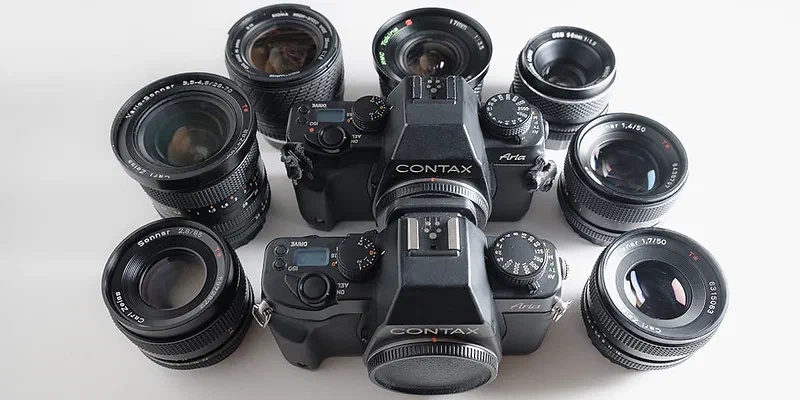
Contax has been one of the hottest camera brands in analog film photography forever. The expensive point and shoot cameras and the even more expensive Contax 645 system have been hyped for years. But not many people mention the Contax 35mm SLR system, also known as the C/Y mount system. This is my favorite 35mm SLR system, and here’s why.
Why and why not
There are quite a lot of 35mm film camera systems out there, so which one should you pick?
One thing to consider is SLR vs. rangefinder. Rangefinders are good for street and people photography: you can see a bit of what’s outside the frame, so you can tell whether a subject is about to walk into your shot. SLRs are better for landscape or cityscape photography, since you see exactly what you’re going to get, whereas the frame lines in a rangefinder (depending on the camera) are often pretty small, especially for longer focal lengths.
Another important thing is the lens selection. A lot of camera systems died after a few years and never got many lenses. Contax is pretty good here. The Zeiss glass is awesome (if film people love these lenses so much, there’s probably a reason), and there’s something in every focal length you need.
You should also check whether it’s a dead camera system, and if so, for how long it has been dead. I think this is probably the biggest downside of the Contax SLR cameras. They were produced for 30 years until the early 00’s, which is good, but that can’t compare to Canon EF (which was produced until recently) or Leica M (which is still in production). You can even buy a brand-new Leica M6, and Leica will also service it.
Is the camera system sexy, and does it inspire you? For Contax SLRs, a big yes.
Reliability: are there a lot of problems with this kind of camera? In my experience, older SLR cameras often do have problems. For example, I had so many problems with every Canon FD camera I bought that I just gave up on that system. Some will probably disagree with me, but I would say stay away from cameras from the 70’s and 80’s, and get one from the 90’s or early 00’s.
For me it comes down to Contax SLRs, Nikon F, Canon EF (there are also manual focus EF cameras and lenses) and Leica M. I need an SLR for my cityscape photography, so Leica is not an option. I was never very interested in Nikon (even though they were king back in the day), so for me it’s either Contax SLRs or Canon EF, and I actually own both. Of course there are lots of other 35mm camera options out there. These are just the systems that have sparked my interest based on the things I mentioned above.
Contax Aria
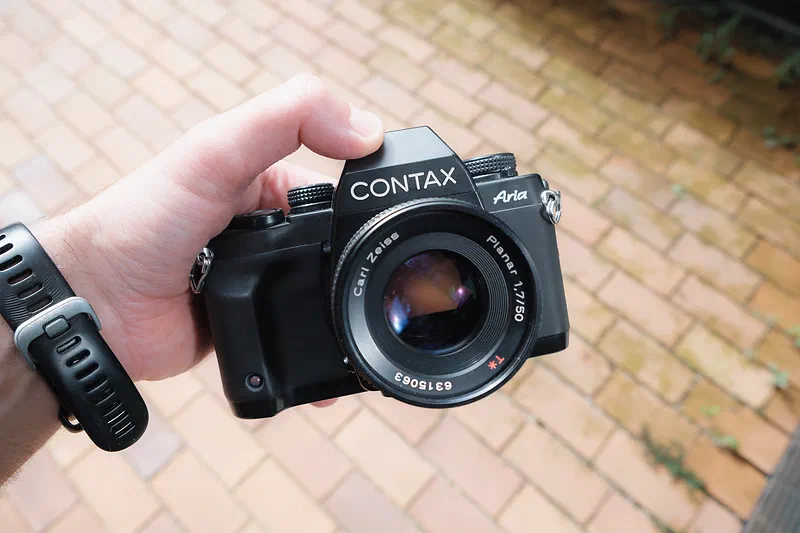
My favorite camera for the C/Y mount is the Contax Aria. It’s small, looks sexy and has a lot of modern features like auto rewind and a good light meter. It’s among the film cameras produced in the late 90’s/early 00’s, so there’s a high chance it still works if you buy one. It has a big, lovely, bright viewfinder that makes it easy to nail focus and also inspires you to go out and shoot. It’s also the smallest of the C/Y cameras. This is the camera I would recommend.
I also tried the Contax RTS I and II. The I is from the 70’s and the II is from the 80’s. Both are more manual than the Contax Aria, but they were meant as more pro models, with the ability to lock up the mirror and better viewfinder coverage. To me their design feels a bit too old, but that’s a personal thing. The Contax RTS II is closer to the modern design of the Contax Aria and has 100% viewfinder coverage (something only a few film SLRs have). On paper it’s the perfect camera, but in reality it’s just too big and clunky. I made a video about the RTS III on Youtube you can check out.
I also tried the Contax 167MT, a camera that often comes up for sale for not much money where I live. It was produced in 1986, and as far as I understand, it was the first “electronic” Contax camera. It has a lot of the modern features the Contax Aria also has, but it’s bigger and clunkier to use. Still, it’s a more affordable option than other Contax cameras.
Yashica also made cameras for this mount, and I was foolish enough to buy a Yashica 108 Multi Program (even after reading bad reviews online). It’s an electronic camera in a plastic body, its features are extremely limited, and worst of all, it kept having issues. I fixed a few of its problems and ended up buying another Yashica 108 Multi Program for spare parts, but in the end I gave up on it. Not worth it. I’m not sure you’ll have the same experience with all Yashica cameras for this mount. I see a lot of people using the older Yashica FX-3, so maybe that’s worth a try.


Mirror Slip Problem
A common problem with all the Contax and Yashica cameras for this mount is mirror slip. The mirror is glued to a metal plate, and if the camera is stored somewhere warm, let’s say a hot attic, the glue softens and the mirror slowly slips down.
Some people online say you can heat up the glue and push the mirror back up. I tried that, but like most other people have reported, it doesn’t work. After a few hours, the mirror moves down again.
The only solution is to remove the mirror, remove the glue and apply a new strip of double-sided tape. Try googling it; there are several guides on how to do this and which tape to buy. I had mixed results. On some cameras it worked, and on others the mirror was back in place but the focusing was still off.
My advice is to check your Contax camera as soon as you buy it. Shoot a roll through it quickly, develop it and see if you can nail focus with the camera (try shooting some focus tests). Otherwise, return it to the seller.

Lenses
One of the biggest highlights of this camera system has to be the lenses. These Zeiss lenses are legendary, and there’s a reason so many cinematographers love them for video and filmmaking. I’m not much of a video producer, but I did try them for video, and they really add a lot of that high-quality cinematic feel (check out this video I uploaded to Youtube where I compared the Contax Zeiss 50mm f1.4).
These are the lenses I would recommend:
- Carl Zeiss Planar T* 50mm f1.7 – I like this lens because it’s pretty small, so it’s a good walk-around lens. Some people claim it’s sharper than the f1.4.
- Carl Zeiss Planar T* 50mm f1.4 – For me this is the ultimate lens: good for shooting handheld in low light, and also great adapted on digital cameras for video work.
- Carl Zeiss Tessar T* 45mm f2.8 – Not my favorite focal length, but this lens basically makes the Contax Aria pocketable. A great little lens.
I was looking for some wide angle options, but wide angle lenses were rarer back in the day and the Zeiss options are pretty pricey, so I ended up buying third-party lenses:
- Tokina RMC 17mm f3.5 – Not that sharp wide open, but I still like this lens. Ultra wide lenses can actually give some cool images on film.
- Sigma MF 28mm f1.8 Aspherical ZEN – The Zeiss alternative was too big and expensive. This one is pretty small, has a fast aperture and is cheap.
I also tried a few of the Yashica lenses that came with the different cameras I picked up. They’re not as sharp as the Zeiss lenses, at least wide open, so I would go for the Zeiss.
The C/Y flange distance isn’t that long, which means you can adapt some other lenses. I got an M42 adapter, since I already had a few M42 lenses. The downside of using an adapter is that the aperture doesn’t automatically stop down when you shoot, so you have to manually open up the aperture to focus and stop it down before you shoot. Apart from that, it’s a cool and cheap addition to your Contax collection. My favorite M42 lenses are the Helios 44-2 58mm f2 (for its interesting bokeh) and the Carl Zeiss Jena Tessar 50mm F2.8 (for its 3D pop rendering).
I have a theory, which I haven’t tested yet, that older low-contrast lenses (like these Contax Zeiss lenses) give more dynamic range than modern lenses (e.g. Canon EF lenses). I’ve noticed that when shooting film with my Canon EF cameras and modern EF lenses, my shadows and highlights were more often blown out than in photos shot with my Contax cameras and Zeiss lenses. I plan to do a test on my blog in the future.
Alternatives
If Contax isn’t for you, what are the alternatives? As I mentioned earlier, a fun option is actually the Canon EF mount. You can get good Canon EF autofocus cameras, but there’s also a fully manual option, the Canon EOS EF-M (split prism, manual dials and everything). And the cool thing is that thanks to the even shorter flange distance, you can adapt Contax (C/Y) lenses with a tiny adapter, or M42 lenses, which gives this camera a huge lens selection. Update: After writing this, I read that not all C/Y to EF adapters work (the camera won’t fire), and nobody knows why some adapters work and others don’t, so it’s probably best to stay away from adapting lenses on the Canon EOS EF-M.
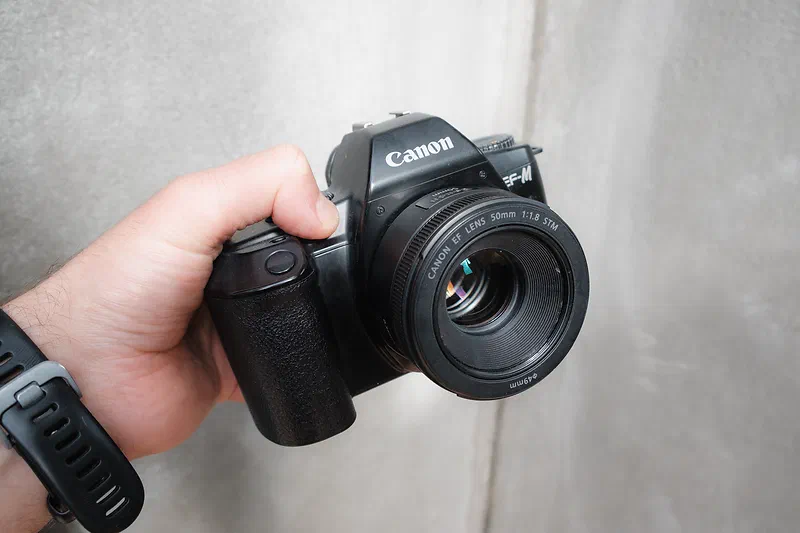
Many EF lenses were made until just a few years ago (I think some are still in production), and there are many interesting third-party lenses, like manual focus Voigtländer lenses (e.g. the tiny pancake Voigtländer 28mm f2.8 Color Skopar or the Voigtländer Ultron 40mm f2, very cool lenses) or the manual focus Zeiss lenses (the Zeiss Planar T* 50mm f1.4 is supposed to be the exact same lens design with updated coatings). Personally, I really like having an autofocus 35mm camera (and there are many great Canon EOS cameras for that), and I’d rather not buy a separate set of lenses just for manual focus. For that, the EF mount is great.
Nikon offers the exact same thing, both autofocus and manual focus SLR cameras. But I’ve read that there are many compatibility problems with newer Nikon AF lenses on older Nikon AF film cameras. I’ve also heard that Canon’s autofocus was superior to Nikon’s back in the film days. For those two reasons, I would pick Canon EF over Nikon F.

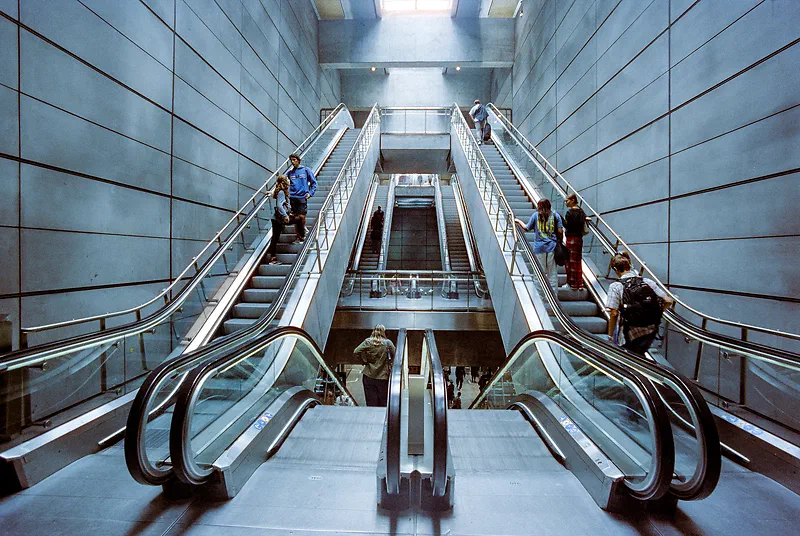
Parking garage on Jernbanegade, Copenhagen, shot with Contax Aria + Carl Zeiss Planar 50mm f1.7 @ f8, 2 sec on a tripod.
Video
Here’s a video that covers most of the things in this blog post, if you’d rather watch than read.
More photos