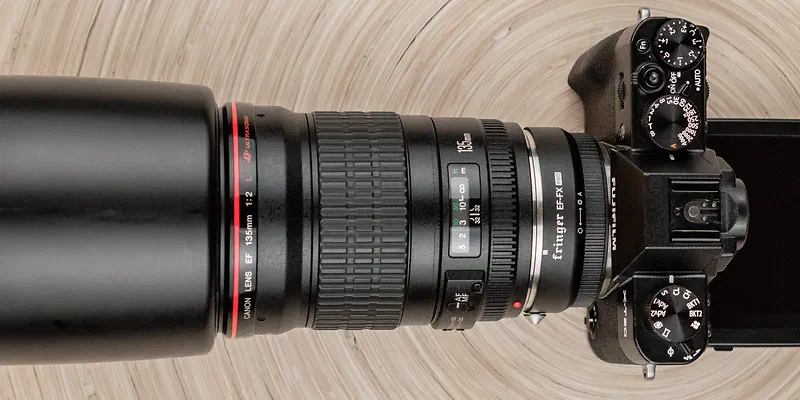
This is a short review of the Fringer Canon EF to Fujifilm X lens adapter. It’s a so-called smart adapter, meaning it lets you use autofocus with Canon lenses on your Fujifilm X camera. Smart adapters for Canon lenses have been available for Sony cameras for some time, but this is the first one for the Fujifilm X system.
I take a lot of photos of bicycles in Copenhagen. They move fast, so it takes good autofocus and long, fast lenses. Fujifilm lacks those longer primes; the longest is the 90mm f2, and that’s too short. I bought this adapter to try out lenses like the 135mm f2, 200mm f2 or 300mm f2.8.
I bought the Canon EF 135mm f2 USM and also borrowed a few other lenses to test it with: the Canon EF 85mm f1.2 L II, Canon EF 50mm f1.8 II and Canon EF-S 18-55mm f3.5-5.6 STM.
Product overview
- Lets you mount Canon EF lenses on your Fujifilm X camera. A long list of lenses has been tested.
- Autofocus works with the lenses.
- Image stabilization also works on lenses that have it.
- An aperture ring for changing the aperture. Turning it all the way to the end sets it to auto.
- Lens EXIF data (focal length and aperture) gets saved.
- The price is $299 when bought from the Fringer website.
Testing the autofocus
After testing it for a few weeks, I can say that the adapter works and autofocus works. The question is how well it works. Will it handle fast-moving subjects?
I tested autofocus on moving subjects coming towards me with these three setups:
- Fujifilm X-T20 + Fujifilm XF 55-200mm f3.5-4.8 at 135mm.
- Fujifilm X-T20 + Fringer adapter + Canon EF 135mm f2.
- Canon 80D + Canon EF 135mm f2

The results were a bit mixed. In single focus mode things work pretty well, and autofocus is only a bit slower than with native Fujifilm lenses. With continuous autofocus the results weren’t good enough: focus was close, but not spot on. My advice would be to only buy this adapter if you don’t shoot a lot of fast-moving subjects (which most people don’t).

Fujifilm X-T20 + Fringer adapter vs. Canon 80D
I bought a Canon 80D to compare with the Fujifilm X-T20 + Fringer adapter. If you already know Canon cameras, this won’t be of much interest to you. But for people like me who only use Fujifilm, here are some interesting observations:
- The Canon 80D focuses a bit faster than the Fringer adapter, but that’s to be expected.
- DSLRs are simply better for serious professional work. The viewfinder is clear, and it’s easy to track fast-moving subjects. Nothing compares to a DSLR when it comes to tracking fast-moving subjects.
- On the other hand, DSLRs are big and clunky. I rarely take photos with it when I’m walking around the streets on my own. So unless your photography is paid professional work, you’ll probably prefer a smaller mirrorless camera with a flip screen.
- Canon colors: I know a lot of gear relativists will disagree (“all gear is basically the same, it’s about your skills”), but there’s something about the colors from some cameras. I dislike Nikon colors, while Fujifilm colors are great, and so are Canon colors. Canon colors are beautiful, especially for golden hour photos of people; it’s the color style you’ve seen everywhere for the last 10 years. Fujifilm has more of an analog film look, slightly more hipster-friendly colors. I like both.
- Photos from Canon lenses look better on a Canon camera than on a Fujifilm camera. They seem to lack some color and contrast compared to shots taken with a Canon camera or with native Fujifilm lenses. Colors from the Fringer look very blue (compared to native Canon or Fujifilm results), and it’s not easy to fix in post.

Conclusion
I would recommend sticking to native Fujifilm lenses.
Pros:
- Basic autofocus works.
- EXIF data gets stored in your images.
- Keeps getting better through firmware updates.
Cons:
- Autofocus works, but only in single focus mode. In continuous focus it doesn’t nail focus every time.
- The colors and rendering aren’t like native Fujifilm lenses, and that’s not easy to fix in post-production.
2023 Update
I sold the adapter shortly after writing this blog post. But in 2023 I’ve been shooting more analog film with my old Canon EOS film cameras, and I got tired of carrying lenses for both those and my digital Fujifilm X cameras. So I bought a Fringer adapter again, this time the Fringer EF-FX II, a newer, updated version. I was excited to see whether Fringer had managed to make the images look better (maybe by applying some kind of lens profile?).
Autofocus was better. They claim phase detection now works, and I guess you could use it for moving subjects now. But the image quality problems were still the same. This time I’d collected even more EF lenses, and all of them gave me very bleak images, with a strong blue color cast that was hard to remove, and very high contrast. Highlights were often blown out and shadows often crushed. I’m not sure what’s going on. On my Canon cameras I don’t notice the problem at all. My theory is that these Canon EF lenses maybe aren’t that great, but Canon applies some kind of correction profile to the images (making them less blue, lowering contrast, plus something else I can’t emulate). Those Canon EF lenses also don’t seem that sharp on Fujifilm X.
I would stay away unless Canon EF is your main camera system and Fujifilm X is your second or third, and you just want to be able to use some of the lenses you already have on your Fuji.
Links
- Fringer’s official product page – where you can also order the adapter. If it’s out of stock, try writing to them.